Category: Business Management

  • Asset Sale vs Business Sale – What’s the Difference?

    Asset Sale vs Business Sale – What’s the Difference?

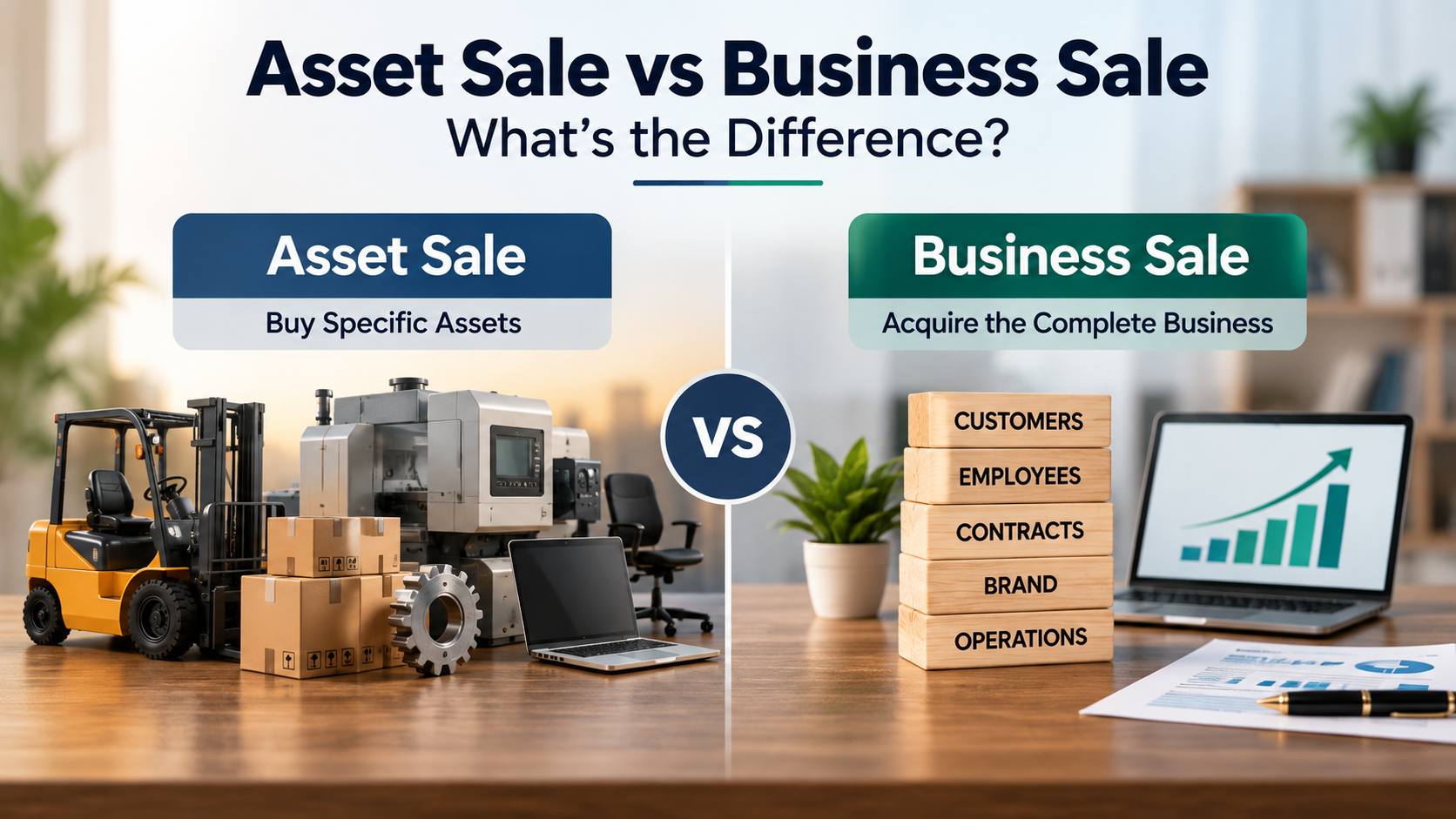
    Selling a business is not always the same as selling its assets. While the terms are sometimes used interchangeably, an asset sale and a business sale can involve very different things.

    The biggest difference is what the buyer is actually acquiring.

    In an asset sale, the transaction generally focuses on selected assets of the business, such as machinery, equipment, inventory, furniture, vehicles, intellectual property, or other specified assets. In a business sale, the buyer may acquire the operating business as a whole, including its established operations, assets, customer relationships, contracts, goodwill, and other elements included in the transaction.

    Understanding this difference is important for both buyers and sellers because it can affect the price, liabilities, contracts, employees, licences, taxes, and the way the transaction is structured.

    This guide explains the difference between an asset sale and a business sale in simple terms.

    What Is an Asset Sale?

    An asset sale is a transaction where a buyer purchases specific assets belonging to a business rather than necessarily acquiring the entire business entity.

    For example, a manufacturing business might sell:

    • Machinery
    • Production equipment
    • Furniture
    • Vehicles
    • Inventory
    • Computers
    • Tools
    • Certain intellectual property
    • Other specified business assets

    The buyer and seller generally identify which assets are included in the transaction.

    The business itself may continue to exist after the sale unless the seller decides to close or restructure it.

    Simple Example

    Imagine a manufacturing unit owns machinery, equipment, inventory, furniture, and other assets.

    A buyer may be interested only in purchasing the machinery and equipment to use in another operation.

    In that situation, the transaction can be structured around those specific assets rather than the entire operating business.

    What Is a Business Sale?

    A business sale generally involves the transfer of an operating business or an ownership interest in the entity that owns and operates the business.

    Depending on the structure, the buyer may acquire a combination of:

    • Business assets
    • Customer relationships
    • Brand or trade name
    • Goodwill
    • Employees
    • Supplier relationships
    • Business processes
    • Contracts
    • Intellectual property
    • Inventory
    • Equipment
    • Business premises or lease rights
    • Other operating components

    The exact scope depends on the agreement between the buyer and seller and the legal structure of the transaction.

    BizzXchange’s marketplace, for example, includes opportunities across different business structures and industries, with listings showing information such as business nature, industry, asking amount, equity offered, turnover, and EBITDA where provided.

    Why Does the Difference Matter to a Buyer?

    For a buyer, the difference between an asset sale and a business sale can significantly affect the opportunity.

    Buying Assets

    If you purchase selected assets, you may have to build or arrange the rest of the operation yourself.

    For example, buying machinery does not automatically give you:

    • Existing customers
    • Employees
    • Supplier relationships
    • Brand recognition
    • Established revenue
    • Operating processes

    The value may therefore be concentrated in the assets themselves.

    Buying an Operating Business

    When purchasing an operating business, the buyer may be acquiring a combination of tangible and intangible value.

    This can include:

    • Existing customers
    • Revenue history
    • Employees
    • Supplier relationships
    • Brand
    • Business processes
    • Equipment
    • Inventory
    • Established location

    However, an operating business may also come with existing obligations and risks, which is why proper due diligence is important.

    Why Does the Difference Matter to a Seller?

    For a seller, the choice between selling assets and selling an operating business can affect the transaction structure and what remains after the sale.

    A seller should consider:

    • Which assets are being sold?
    • Is the business continuing after the transaction?
    • Are contracts transferable?
    • What happens to employees?
    • What happens to existing liabilities?
    • Is the brand included?
    • Is intellectual property included?
    • Is inventory included?
    • What happens to the business premises?
    • How will the transaction be documented?

    The seller should also understand whether the buyer is interested in the entire operating business or only specific assets.

    Asset Sale vs Business Sale: Which One Is Better?

    There is no universal answer.

    The appropriate structure depends on the circumstances of the buyer, seller, business, assets, liabilities, contracts, tax considerations, and applicable legal requirements.

    An asset-focused transaction may make sense when:

    • The buyer wants specific assets.
    • The buyer does not want the entire business.
    • Particular equipment or property is the main attraction.
    • The parties want to clearly identify what is being transferred.

    A business acquisition may make sense when:

    • The buyer wants an operating business.
    • Existing customers are important.
    • The business has established revenue.
    • Employees and operating systems are valuable.
    • The buyer wants to continue an existing business model.

    The decision should be evaluated based on the specific transaction rather than assuming one structure is always preferable.

    Documents to Review Before a Transaction

    Depending on the type of transaction, buyers and sellers may need to review documents such as:

    • Business registration documents
    • Ownership records
    • Financial statements
    • Tax records
    • Loan documents
    • Asset lists
    • Inventory records
    • Property or lease documents
    • Employee records
    • Major customer and supplier agreements
    • Licences and permits
    • Intellectual property records
    • Legal documents
    • Insurance records

    Not every document needs to be shared at the earliest stage. Sensitive information should be handled carefully and shared at the appropriate stage of the transaction.

    Common Mistakes to Avoid

    Focusing Only on the Asking Price

    A low purchase price does not necessarily mean a better opportunity. Buyers should understand what is actually included.

    Assuming All Liabilities Are Excluded

    The treatment of liabilities depends on the transaction structure and applicable agreements. Buyers should verify this rather than make assumptions.

    Ignoring Intangible Assets

    Customers, brand recognition, intellectual property, supplier relationships, and established processes can have significant commercial value.

    Failing to Verify Asset Ownership

    Before purchasing an asset, confirm that the seller has the right to sell it and identify any financing, security interests, or other restrictions that may apply.

    Not Reviewing Contracts

    Important business relationships may depend on contracts that contain assignment, change-of-control, termination, or other relevant provisions.

    Relying Only on Seller-Provided Numbers

    Financial information should be reviewed and verified through appropriate due diligence.

    Asset Sale or Business Sale: The Key Takeaway

    The simplest way to remember the difference is:

    An asset sale focuses on what the business owns. A business sale focuses on the operating business and the elements that allow it to continue as an enterprise.

    An asset transaction can involve selected machinery, inventory, equipment, property, intellectual property, or other identified assets.

    A business acquisition can involve a broader combination of assets, customers, employees, contracts, goodwill, operations, and other components of an established business.

    The right approach depends on what the buyer wants to acquire and what the seller wants to transfer.

    For significant transactions, buyers and sellers should obtain appropriate professional advice to understand the legal, tax, financial, and contractual implications of the proposed structure.

    Find Business Opportunities on BizzXchange

    If you are considering buying an existing business rather than building one from scratch, BizzXchange provides an online marketplace where buyers can explore business and investment opportunities across different industries and locations in India. The platform allows users to filter opportunities by factors such as business nature, industry, and established year, and individual listings can provide information such as asking amount, equity offered, turnover, and EBITDA where available.

    BizzXchange also supports sellers looking to present their businesses to potential buyers through its online platform.

    Whether you are looking to buy a running business, sell an existing business, or explore investment opportunities, start by understanding exactly what is being offered and carry out appropriate due diligence before making a decision.

  • Business Valuation in India: How to Determine What a Business Is Worth

    Business Valuation in India: How to Determine What a Business Is Worth

    If you’re planning to buy or sell a business, one of the first questions you’ll probably ask is:

    “How much is the business actually worth?”

    There isn’t a single formula that works for every company.

    A profitable manufacturing company, a restaurant, an IT services company, and a small retail business can all require different approaches to valuation.

    Understanding the basics of business valuation in India can help buyers make more informed decisions and help sellers establish more realistic expectations.

    What Is Business Valuation?

    Business valuation is the process of estimating the economic value of a business.

    A valuation can consider:

    • Revenue
    • Profit
    • Assets
    • Liabilities
    • Cash flow
    • Customers
    • Brand
    • Intellectual property
    • Employees
    • Market conditions
    • Growth potential
    • Industry outlook

    The objective is to develop a reasonable understanding of what the business may be worth.

    Why Is Business Valuation Important?

    Imagine that a business owner is asking ₹1 crore for a company.

    At first glance, the price may seem reasonable.

    But what if:

    • Revenue has been declining?
    • Most sales come from one customer?
    • The business has significant debt?
    • Equipment needs replacement?
    • Profits are dependent on the owner?
    • The industry is becoming less attractive?

    Without proper evaluation, the buyer may pay more than the business is actually worth.

    A valuation helps create a stronger foundation for negotiation and decision-making.

    1. Revenue-Based Valuation

    Revenue is one of the easiest numbers to understand, but revenue alone does not tell you what a business is worth.

    Two businesses can generate ₹1 crore in annual revenue but have completely different profitability.

    For example:

    Business A

    Revenue: ₹1 crore
    Profit: ₹25 lakh

    Business B

    Revenue: ₹1 crore
    Profit: ₹5 lakh

    Although both businesses generate the same revenue, their financial profiles are very different.

    Therefore, revenue should generally be considered alongside profitability and other financial factors.

    2. Profit-Based Valuation

    Profit is often an important part of business valuation.

    Buyers want to understand how much money the business generates after accounting for its operating expenses.

    Depending on the business, valuation may consider metrics such as:

    • Net profit
    • EBITDA
    • Operating profit
    • Seller’s discretionary earnings

    The appropriate metric depends on the type and size of the business.

    3. Asset-Based Valuation

    For businesses with significant physical assets, an asset-based approach may be useful.

    Assets could include:

    • Property
    • Machinery
    • Equipment
    • Vehicles
    • Inventory
    • Furniture
    • Technology

    The valuation should also account for liabilities and obligations.

    A business with ₹1 crore worth of assets does not necessarily have a ₹1 crore valuation if it also has substantial debt or other liabilities.

    4. Cash Flow

    Cash flow is another important consideration.

    A business can report profits but still experience cash-flow problems.

    Buyers should therefore examine:

    • Money coming into the business
    • Operating expenses
    • Debt payments
    • Working capital requirements
    • Seasonal fluctuations
    • Receivables

    A healthy and predictable cash flow can make a business more attractive to potential buyers.

    5. Customer Concentration

    The customer base can significantly affect the value and risk profile of a business.

    Consider two companies.

    Company A:
    500 customers generating revenue across multiple markets.

    Company B:
    5 customers generating most of the revenue.

    Company B may have greater concentration risk.

    If one major customer leaves after the acquisition, revenue could fall substantially.

    Therefore, customer diversification should be considered during valuation.

    6. Industry and Market Conditions

    The industry in which the company operates also matters.

    A business operating in a growing market may have stronger future potential than one operating in a declining market.

    Consider:

    • Market size
    • Competition
    • Industry growth
    • Customer demand
    • Regulatory environment
    • Technology changes
    • Future opportunities

    A business with strong growth potential may command a different valuation than a similar business in a stagnant market.

    Common Mistakes When Valuing a Business

    Mistake 1: Looking Only at Revenue

    High revenue doesn’t automatically mean high value.

    Mistake 2: Ignoring Debt

    Outstanding liabilities can materially affect the actual value of an acquisition.

    Mistake 3: Accepting the Asking Price

    The seller’s asking price is not necessarily the fair market value.

    Mistake 4: Ignoring Future Risks

    A business may look profitable today but face significant challenges tomorrow.

    Mistake 5: Not Getting Professional Advice

    Depending on the transaction, professional financial, tax, and legal advice can help identify issues that a buyer may otherwise miss.

    Business valuation is not simply about putting a number on a company.

    It is about understanding what generates the company’s value, how sustainable that value is, and what risks could affect it in the future.

    If you’re considering buying a business in India, take time to understand the financials, assets, customers, liabilities, industry, and growth potential before negotiating a final price.

    A well-researched valuation can help buyers make better acquisition decisions and give sellers a stronger foundation for negotiations.

    Looking for businesses to buy in India?
    Explore BizzXchange to discover available business opportunities and find potential acquisitions that match your requirements.

  • Business Investment vs Stock Market Investment: Which Is Better?

    Business Investment vs Stock Market Investment: Which Is Better?

    When you have money to invest, one common question is: should you invest in a business or put your money into the stock market?

    There is no single answer that works for everyone.

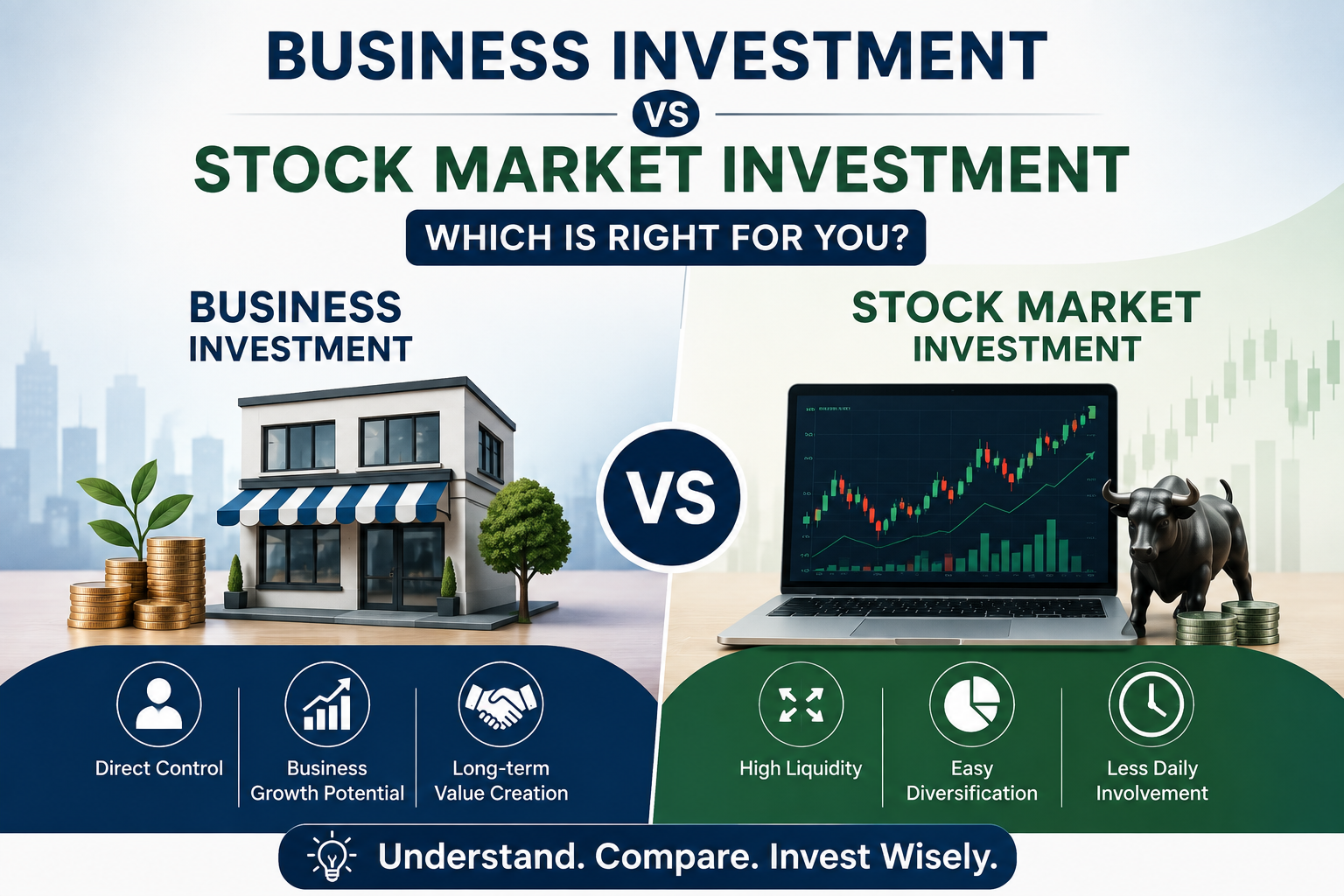
    A business investment can give you direct ownership and greater involvement in an operating business. A stock market investment allows you to own shares of companies without managing their day-to-day operations. The right choice depends on your capital, risk tolerance, time, business knowledge, investment goals and how actively you want to be involved.

    For someone who wants to build or acquire a business, investing in a running business can be an interesting alternative to simply buying financial assets. On the other hand, investors who prefer liquidity and less day-to-day involvement may find the stock market more suitable.

    Let’s compare both options in simple terms.

    What Is Business Investment?

    Business investment means putting money into an operating business, acquiring an existing business, buying a share in a company or investing in a business opportunity with the expectation of earning a return.

    For example, you may invest in:

    • A running retail business
    • A manufacturing unit
    • A restaurant or food business
    • A service business
    • A technology business
    • A hospitality business
    • A rental or accommodation business
    • A growing private company
    • An existing local business

    When you invest in or acquire a business, your returns may come from business profits, increased business value, future growth or eventually selling your ownership.

    The major difference is that you are investing directly in a business rather than simply buying shares that trade in the market.

    What Is Stock Market Investment?

    Stock market investment means buying shares or other securities through the securities market.

    When you purchase shares of a company, you become a shareholder. Your investment value can increase if the share price rises, and some companies may distribute dividends, although dividends are not guaranteed.

    Stock prices can also move up and down because of company performance, economic conditions, market sentiment and other factors. There is no guaranteed return from equity investment.

    For this reason, investors should consider their goals, investment horizon and ability to handle losses before investing.

    Business Investment vs Stock Market Investment

    The biggest difference is control and involvement.

    With a business investment, you may have a direct role in the business and its decisions, depending on the ownership structure.

    With stock market investment, you generally have much less involvement in daily business operations. You are investing in the company’s ownership through shares.

    Here is a simple comparison:

    FactorBusiness InvestmentStock Market Investment
    OwnershipDirect or private ownershipOwnership through shares
    Daily involvementCan be highUsually low
    ControlPotentially higherUsually limited
    LiquidityOften lowerGenerally higher for actively traded shares
    Research requiredBusiness, financial and legal checksCompany and market research
    Income potentialBusiness profits and growthPrice appreciation and possible dividends
    RiskBusiness-specific and financial risksMarket and company-specific risks
    Time commitmentCan be significantUsually much lower
    ExitMay take time to find a buyerShares can generally be sold through the market
    Knowledge requiredBusiness operations and industryFinancial markets and company analysis

    The table shows why these two investments are very different even though both are made with the expectation of generating returns.

    Which Has Higher Returns: Business or Stock Market?

    This is one of the most searched questions, but there is no fixed answer.

    A successful business can potentially generate substantial returns because the owner may directly influence sales, expenses and growth.

    At the same time, a business can lose money or even fail.

    Stocks can also generate significant long-term returns, but prices can fall and returns are never guaranteed.

    Therefore, it is not accurate to say:

    “Business investment always gives higher returns.”

    It is equally incorrect to say:

    “The stock market is always better.”

    The potential return depends on the specific business or investment, purchase price, management, market conditions, time horizon and risks involved.

    Business Investment vs Stock Market: Which Is More Risky?

    Both can be risky, but the type of risk is different.

    When you buy a running business, you may be exposed to operational risks such as:

    • Employees
    • Customers
    • Suppliers
    • Rent
    • Competition
    • Cash flow
    • Business liabilities
    • Regulatory requirements

    When you invest in stocks, you are more exposed to:

    • Share price volatility
    • Market-wide movements
    • Company performance
    • Economic conditions
    • Investor sentiment

    The important thing is to understand the risk before investing rather than simply looking at the potential return.

    Which Is Better for a First-Time Investor?

    For a first-time investor, the answer depends heavily on personal circumstances.

    If you have:

    • Strong business experience
    • Knowledge of a particular industry
    • Sufficient capital
    • Time to manage a business
    • Ability to conduct due diligence

    then acquiring a running business may be worth exploring.

    If you:

    • Prefer passive investing
    • Want easier liquidity
    • Have limited business-management experience
    • Want to diversify across companies
    • Do not want daily operational responsibility

    then stock market investment may be more suitable.

    There is no requirement to choose only one.

    Some investors may decide to build a diversified investment portfolio while also using their experience and capital to acquire or invest in a business.

    Should You Invest in a Running Business or Stocks?

    Ask yourself these questions before deciding.

    Do You Want to Run a Business?

    If the answer is yes, business investment may be more interesting.

    Do You Want a More Hands-Off Investment?

    If yes, stocks may fit better.

    How Much Capital Do You Have?

    Buying an established business can require significantly more capital than starting a small stock portfolio.

    How Much Risk Can You Handle?

    Both options carry risk. Your decision should reflect how much loss you can realistically afford.

    How Much Time Can You Give?

    A business may require daily attention. Stock investing generally requires much less operational involvement.

    Do You Understand the Investment?

    This is perhaps the most important question.

    Do not invest simply because someone says an opportunity will generate high returns.

    Research the investment, understand the business model and assess the risks.

    What Should You Check Before Investing in a Business?

    If you decide to explore business investment, do not stop at the asking price.

    Check:

    Financial Performance

    Review revenue, profit, expenses and cash flow.

    Liabilities

    Find out about loans, unpaid dues, tax obligations and other commitments.

    Assets

    Verify machinery, equipment, inventory, property rights and other assets included in the transaction.

    Customers

    Understand how the business gets its customers and whether revenue depends heavily on a few clients.

    Employees

    Check the number of employees, salaries, key personnel and whether important staff members are likely to stay.

    Legal Documents

    Review registrations, licenses, agreements, ownership documents and other relevant paperwork.

    Business Valuation

    The asking price should be compared with the actual financial performance, assets, liabilities and future potential of the business.

    BizzXchange also provides business-related services including business valuation and due diligence, which are relevant considerations when evaluating an acquisition or investment opportunity.

    What Should You Check Before Investing in Stocks?

    If you choose the stock market, avoid investing purely because of a social-media tip or short-term market excitement.

    Before investing, consider:

    • Your financial goals
    • Investment horizon
    • Risk tolerance
    • Company fundamentals
    • Business model
    • Revenue and profitability
    • Debt
    • Valuation
    • Industry conditions
    • Diversification

    Due diligence should be part of the investment process. Understanding the company and reviewing relevant financial information can help you make a more informed decision.

    Business Investment vs Stock Market Investment: Quick Summary

    If you want control and active involvement, consider exploring business investment.

    If you want liquidity and less operational involvement, the stock market may be more suitable.

    If you have industry experience, a running business may give you an opportunity to use that knowledge.

    If you want diversification, the stock market can make it easier to spread investments across different companies and sectors.

    If you want to build and grow something yourself, business ownership may be more attractive.

    If you want to invest without managing employees or customers, stock market investing may be a better fit.

    Neither option is automatically better.

    How BizzXchange Can Help You Explore Business Investment Opportunities

    For people interested in business investment, the first challenge is often finding suitable opportunities to evaluate.

    BizzXchange provides a platform for exploring businesses available for sale or investment. Buyers can identify their requirements, search business opportunities using available filters, review listings and connect with sellers or express interest.

    The platform includes opportunities across different industries and locations, making it possible to compare businesses based on factors such as business nature, industry, established year, equity offered and other available listing information.

    You can explore business investment opportunities on BizzXchange and compare available businesses based on your requirements.

    Remember that an online listing is only the starting point. Financial, legal and operational information should be independently verified before entering into any transaction.

    BizzXchange can help you discover businesses available for sale or investment and compare opportunities before you take the next step.

    The best investment is not necessarily the one promising the highest return. It is the one you understand, can afford, and can manage within your risk level.

    This article is for general educational purposes and should not be treated as financial or investment advice. Investment decisions should be made after considering your individual circumstances and, where appropriate, taking professional advice.

  • What are the benefits of start-up Registration in India?

    What are the benefits of start-up Registration in India?

    Detailed Benefits of Startup Registration in India

    1.Income Tax Exemption (Major Benefit)

    Eligible startups get a 100% tax exemption on profits for 3 consecutive years out of the first 10 years under Section 80-IAC.

    Practical Impact:

    • If your startup earns ₹10 lakh profit/year → you save ~₹2.5–3 lakh tax annually
    • Helps in reinvesting money into business growth instead of paying taxes

    Conditions:

    • Must be recognized by DPIIT
    • Should be innovative or scalable

    2. Angel Tax Exemption (Big Relief for Funding)

    Normally, if a company receives investment above fair value, it is taxed (Angel Tax).

    Registered startups get exemption under Section 56, meaning:

    • No tax on funds received from investors
    • Attracts angel investors easily

    Example:
    If your startup gets ₹50 lakh investment → no extra tax liability

    3.Easy Compliance & Self-Certification

    Startups can self-certify compliance under:

    • 6 Labour Laws
    • 3 Environmental Laws

    Benefits:

    • No frequent inspections
    • Less legal pressure
    • Saves compliance cost

     Ideal for new entrepreneurs who don’t want heavy legal burden initially.

    4.Fast-Track Patent, Trademark & IPR

    With support from the government:

    • 80% rebate on patent filing fees
    • 50% rebate on trademark filing
    • Fast-track processing

    Supported by organizations like SIDBI.

    Practical Benefit:

    • Protect your brand and innovation at low cost
    • Faster approval → competitive advantage

    5.Easy Access to Funding & Government Schemes

    Government has created a Fund of Funds (₹10,000+ crore corpus) to support startups.

    Startups get:

    • Access to venture capital funding
    • Startup grants
    • Priority in MSME & innovation schemes

    Supported by initiatives like Atal Innovation Mission.

    6. Easier Participation in Government Tenders

    Normally, tenders require:

    • Minimum turnover
    • Prior experience

    Startups get exemptions:

    • Can apply without experience
    • No turnover requirement

    Benefit:

    • Even a new startup can win government contracts

    7. Easy Exit (Fast Closure)

    Under the Insolvency & Bankruptcy Code (IBC):

    • Startup can close within 90 days

    Why important?

    • Reduces risk for entrepreneurs
    • Encourages experimentation without fear

    8.Better Credibility & Branding

    Being a registered startup:

    • Builds trust with clients & investors
    • Improves business image
    • Helps in partnerships

    Example:
    Investors prefer DPIIT-recognized startups over unregistered businesses.

    9.Networking, Mentorship & Incubation

    Access to:

    • Government incubators
    • Startup events & expos
    • Mentorship programs

    Helps in:

    • Learning from experts
    • Connecting with investors
    • Scaling faster
    • 10.Global Exposure & Expansion

    Registered startups get:

    • Opportunities in international startup programs
    • Government support for global expansion

    Helps in entering foreign markets easily.

    Eligibility (Important)

    To get these benefits, your startup must:

    • Be a Private Limited Company / LLP / OPC
    • Age ≤ 10 years
    • Turnover ≤ ₹100 crore
    • Focus on innovation / improvement / scalable model

    Simple Conclusion

    Startup Registration is highly beneficial if you want to:

    • Save tax
    • Raise funding easily
    • Reduce compliance burden
    • Grow faster with government support
  • Main Board IPO

    Main Board IPO

    Main board IPO issue requirment and process

    1. INTRODUCTION

    A Main Board IPO (Initial Public Offering) is the process by which a large and established company offers its shares to the public for the first time and lists them on the Main Board of a recognized stock exchange (like NSE or BSE in India)

    The Main Board is meant for companies with strong financials, proven track records, and larger market capitalization compared to SME or startup platforms.

    2. ELIGIBILITY CRITERIA

    A. Basic Corporate Requirements

    1. The issuer must be a public limited company under the Companies Act, 2013.
    2. The company must have a track record of profitability and net worth.
    3. The company must not be a wilful defaulter, blacklisted, or involved in any SEBI investigation.
    4. The articles of association should permit public issue of shares.
    5. The company must follow corporate governance standards as per SEBI (LODR) Regulations, 2015.

    B. Financial Criteria (As per SEBI/Exchange Norms)

    ParameterMinimum Requirement
    Net Tangible Assets₹3 crore in each of the preceding 3 full years.
    Net Worth₹1 crore in each of the preceding 3 full years.
    Operating ProfitPositive in at least 3 out of the last 5 years.
    Paid-up Equity Capital (Post-Issue)At least ₹10 crore.
    Distributable Public ShareholdingMinimum 25% of post-issue capital to be offered to the public.
    Promoter’s ContributionMinimum 20% of post-issue capital, locked in for 3 years.
    No DefaultsNo defaults in repayment of loans/debentures.

    If a company does not meet these requirements, it can consider an SME IPO or direct listing through alternate routes.

    C. Other Eligibility Conditions

    • The company’s name should not resemble any existing listed company.
    • The company must have fully paid-up shares (no partly paid shares).
    • Promoters and directors should have clean track records (no pending SEBI or RBI cases).
    • The company should have at least 1,000 prospective investors willing to participate.

    3. STAKEHOLDERS INVOLVED IN AN IPO

    StakeholderRole & Responsibility
    Merchant Banker (Lead Manager)Designs IPO structure, conducts due diligence, prepares documents, coordinates with SEBI and stock exchanges.
    Legal AdvisorConducts legal due diligence, reviews material contracts, drafts offer documents.
    Statutory AuditorProvides audited financial statements and certifications.
    Registrar to the Issue (RTI)Handles investor applications, allotments, refunds.
    UnderwriterGuarantees minimum subscription.
    Bankers to the IssueManage collection of application money.
    Advertising / PR AgenciesHandle marketing, branding, and investor roadshows.
    Compliance OfficerEnsures all statutory and disclosure requirements are met.

    4. DETAILED IPO PROCESS (STEP-BY-STEP)

    STEP 1: Corporate Decision & Internal Preparation

    • Board passes a resolution approving the IPO plan.
    • Shareholders approve the public issue and any increase in authorized capital.
    • Company converts to public limited company (if private earlier).
    • Appointment of intermediaries (merchant banker, legal advisor, registrar, etc.).

    Documents:

    • Board Resolution
    • Shareholders’ Resolution
    • Engagement Letters with Intermediaries

    STEP 2: Due Diligence & Drafting

    A. Financial Due Diligence

    • Verification of last 3–5 years’ financial statements.
    • Check for contingent liabilities, related party transactions, and compliance.

    B. Legal Due Diligence

    • Verify property titles, intellectual property, litigation, corporate records, and statutory approvals.

    C. Drafting Key Documents

    • Draft Red Herring Prospectus (DRHP) prepared jointly by the company and lead manager.
    • Contains: business details, management info, risk factors, financial data, objects of the issue, etc.

    STEP 3: Filing with SEBI and Stock Exchanges

    • DRHP is filed with SEBI and the stock exchanges (NSE/BSE).
    • SEBI reviews the DRHP and issues observations/comments (typically within 30 days).
    • The company responds to comments and updates the document.

    Output:

    • Final Red Herring Prospectus (RHP) after incorporating SEBI’s feedback.

    STEP 4: Marketing and Investor Outreach

    • Conduct roadshows and presentations to institutional and retail investors.
    • Media campaigns to create investor awareness.
    • The goal: generate investor interest and gauge demand.

    STEP 5: Pricing & Book-Building

    There are two pricing methods:

    1. Fixed Price Issue

    • Price determined before issue opens.

    2. Book-Building Issue (common method)

    • Price band set (e.g., ₹350–₹370 per share).
    • Investors bid for quantity and price within band.
    • Final price discovered based on bids (cut-off price).

    Investor Categories:

    • QIBs (Qualified Institutional Buyers): 50% reservation.
    • Non-Institutional Investors (HNIs): 15%.
    • Retail Individual Investors (RIIs): 35%.

    STEP 6: Allotment and Refund

    • Issue closes → bids analyzed → shares allotted based on demand.
    • Oversubscription handled via proportionate allotment.
    • Unsuccessful bidders get refunds via bank accounts.
    • Shares credited to investors’ Demat accounts.

    STEP 7: Listing and Trading

    • Company files listing application with exchanges.
    • Stock exchanges verify compliance and grant trading approval.
    • Shares start trading on the Main Board (BSE/NSE).

    Listing Ceremony: Often a public event marking the company’s entry into the market.

    STEP 8: Post-IPO Compliance

    After listing, the company must adhere to continuous listing obligations, including:

    RequirementFrequency
    Financial ResultsQuarterly & Annually
    Board MeetingsMinimum 4 per year
    Shareholding PatternQuarterly Disclosure
    Corporate Governance ReportQuarterly
    Related Party TransactionsOngoing Disclosure
    Insider Trading RegulationsContinuous
    Minimum Public Shareholding25% always

    Non-compliance can result in fines, suspension, or delisting.

    5. DOCUMENTATION REQUIRED

    CategoryDocumentDescription
    Corporate ApprovalsBoard & Shareholder ResolutionsTo approve IPO, issue of shares, and appointment of intermediaries.
    Financial DocumentsAudited Financials (3–5 years)As per Ind-AS, certified by statutory auditor.
    Offer DocumentsDRHP, RHP, ProspectusDisclosure documents submitted to SEBI and public.
    Legal DocumentsDue Diligence Report, Material Contracts, Licenses, Property TitlesProof of legal and business legitimacy.
    CertificatesDue Diligence Certificate (by Lead Manager)Confirms verification of all disclosures.
    AgreementsBetween Company and IntermediariesMerchant Banker, Registrar, Bankers to Issue, etc.

    6. TYPICAL TIMELINE

    PhaseDuration
    Internal Preparation & Due Diligence1–2 months
    DRHP Drafting & Filing1 month
    SEBI Review & Observations1–2 months
    Roadshows & Marketing2–3 weeks
    Issue Open & Close3–5 days
    Allotment, Refunds, Listing~2 weeks
    Total Process Duration6–9 months (average)

    7. KEY BENEFITS OF MAIN BOARD IPO

    • Access to large-scale capital for expansion or debt reduction.
    • Enhances brand visibility and corporate image.
    • Enables liquidity for promoters and early investors.
    • Provides valuation benchmark for M&A and employee stock options.
    • Strengthens governance and transparency.

     *BizzXchage providing the services of Main board and SME IPO service*

    8. CHALLENGES & RISKS

    • High regulatory scrutiny and disclosure requirements.
    • Significant cost (merchant banker fees, legal, compliance, etc.).
    • Market volatility can affect subscription and pricing.
    • Ongoing compliance burden post-listing.
    • Possible dilution of promoter control.

  • How fixed assets can be valued while takeover of business?

    How fixed assets can be valued while takeover of business?

    When a business is taken over, valuing its fixed assets (like land, buildings, plant, machinery, furniture, vehicles, etc.) is a key part of determining the overall purchase price. The valuation depends on the purpose of takeover, industry, and negotiation between buyer and seller. Generally, fixed assets can be valued using the following methods:

    BizzXchange also provides the services of Fixed Assets valuation.

    1. Book Value Method

    • Based on the asset values recorded in the seller’s balance sheet.
    • Value = Original cost – Accumulated depreciation.
    • Limitations: May not reflect current market or realizable value, especially for older assets.

    2. Market Value Method

    • Assets are valued at the price they would fetch in the open market.
    • Suitable for land, buildings, and other assets that have an active market.
    • Often determined by independent valuers or appraisers.

    3. Replacement Cost Method

    4. Realizable Value Method

    • Value is estimated at the price that could be realized if the assets were sold today (after deducting selling costs).
    • Useful in liquidation or distressed takeover situations.

    5. Earning Capacity / Utility Value Method

    • Some assets are valued based on their ability to generate economic benefits.
    • For example, a machine that contributes significantly to production efficiency may be valued higher than book or scrap value.

    6. Valuer’s / Expert’s Opinion

    • Professional valuers (chartered engineers, real estate valuers, etc.) may be appointed to assess the fair value.
    • This is especially important in regulated takeovers, mergers, or when disputes may arise.

    ✅ In practice:

    • A mix of methods is used. For example, land & buildings may be valued at market value, machinery at replacement cost, and furniture/fixtures at written-down value.
    • The chosen method depends on the negotiation between buyer and seller, and the accounting/legal framework governing the takeover.
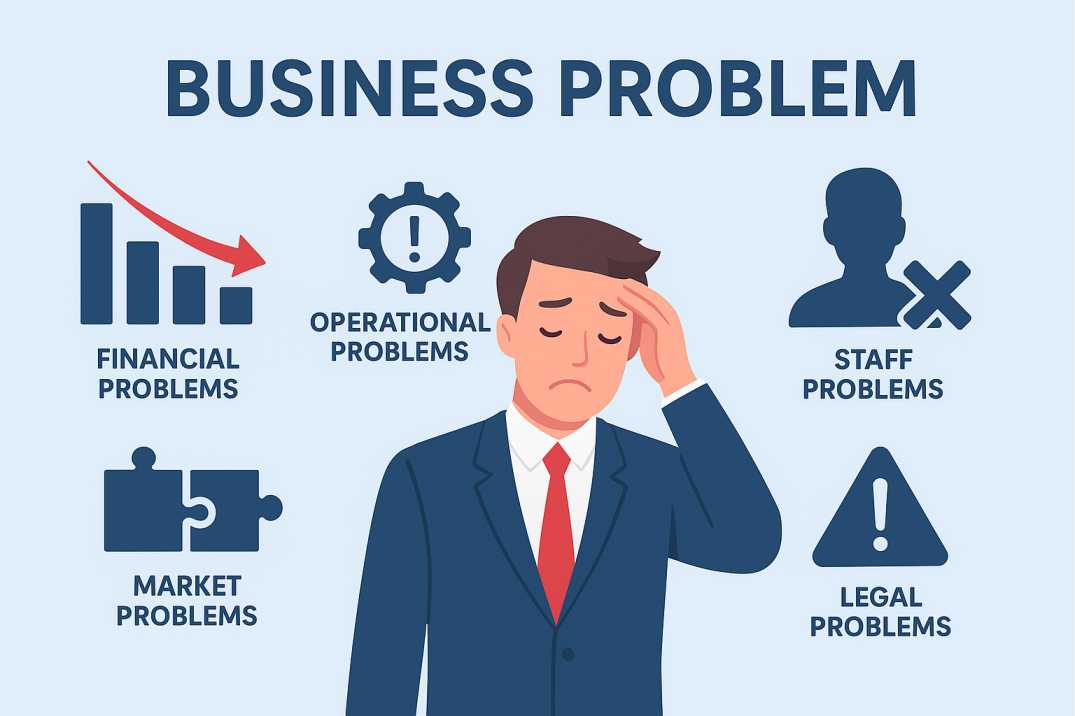
  • What problems generally a business face?

    What problems generally a business face?

    Running a business is never smooth. Every company, whether small or big, faces challenges. These problems can come from inside the business (like money, employees, or management) or from outside the business (like government rules, economy, or competitors).

    Here are the main problems explained in detail:

    1. Financial Problems (Money-Related Issues)

    Money is the lifeline of every business. Without proper cash flow, even a profitable business can collapse.

    • Cash flow gap – Many businesses sell products/services on credit, but expenses like rent, salaries, and bills have to be paid immediately. If customers delay payments, the business suffers.
    • Raising funds – Getting loans from banks can be tough if the company is small or lacks collateral (assets like land or property). Investors may also hesitate if financial records are weak.
    • Bad debts – Some customers never pay, which becomes a direct loss.
    • Rising costs – Raw materials, transport, salaries, and electricity bills often go up, while selling prices may not increase equally.

    👉 Example: A garment shop sells ₹10 lakh worth of clothes on credit in February but customers pay only in June. In March, April and May, the shop struggles to pay salaries and rent.

    2. Market & Competition Problems

    Every business has to deal with changing markets and competition.

    • Too many competitors – Hard to maintain customers when there are many options.
    • Price pressure – If a competitor reduces prices, customers may shift, forcing the business to cut prices and profits.
    • Changing customer preferences – What customers like today may not be in demand tomorrow (e.g., Nokia mobiles lost market share when smartphones arrived).
    • Market saturation – Sometimes, almost everyone already has the product/service (e.g., SIM cards, cable TV connections). In such cases, growth is slow.

    👉 Example: A local cafe struggles when a big coffee chain opens nearby with better offers.

    3. Operational Problems (Day-to-Day Work Issues)

    Operations mean how the business runs every day. Problems here directly affect efficiency.

    • Inefficient processes – Using outdated methods or manual work increases costs and delays.
    • Supply chain issues – Raw materials may arrive late or be too expensive.
    • Over-dependence – Relying only on one supplier or one big customer is risky. If they stop, the business may collapse.
    • Technology gap – If the business doesn’t adopt modern technology (like digital payments or online sales), it loses out to competitors.

    👉 Example: A small manufacturer cannot deliver on time because raw material from China is delayed, so clients shift to another supplier.

    4. Human Resource Problems (People Issues)

    Employees are the backbone of a company, but managing them is tough.

    • Hiring skilled workers – Talented employees prefer bigger companies with higher pay.
    • High turnover – Employees leave for better salaries, creating instability.
    • Low productivity – Untrained or unmotivated workers slow down business.
    • Conflicts – Disagreements between staff or with management hurt teamwork.

    👉 Example: A software startup loses its best developers to bigger IT companies, delaying projects and losing clients.

    5. Legal & Compliance Problems (Rules & Regulations)

    Businesses must follow government laws, but frequent changes create problems.

    • Changing rules and regulations– Tax laws, GST rates, labour laws, or industry policies may change suddenly.
    • Penalties & Fines – Late filing of GST or ROC returns results in fines.
    • Intellectual property theft – Competitors may copy your product, logo, or design.
    • Licensing issues – Missing permits can shut down operations.

    👉 Example: A restaurant runs without a proper food license (FSSAI). Authorities raid and close it, causing huge loss.

    6. Management & Strategy Problems

    Bad management decisions often create bigger troubles.

    • No clear vision – Businesses fail if they don’t know their long-term goal.
    • Poor planning – Spending too much money on the wrong things.
    • Resistance to change – Sticking to old ways when the market is changing fast.
    • Dependence on one person – If the founder or one key manager leaves, the business struggles.

    👉 Example: Kodak ignored digital cameras and focused only on film cameras, which ruined the company.

    7. External Problems (Outside Control)

    Some problems are not in the business’s control but still affect it.

    • Economic slowdown – People spend less during recession, so sales fall.
    • Inflation – Prices of materials rise, reducing profit margins.
    • Government policies – New taxes, import/export restrictions, or bans can hurt industries.
    • Natural disasters / pandemics – Events like floods, earthquakes, or Covid-19 can suddenly stop business operations.

    👉 Example: During Covid-19, gyms, theatres, and travel businesses faced total shutdowns.

    And there are other problems time to time they occur. Because of these problems sometime a business try to quit and then BizzXchange helps in solving these problems.